
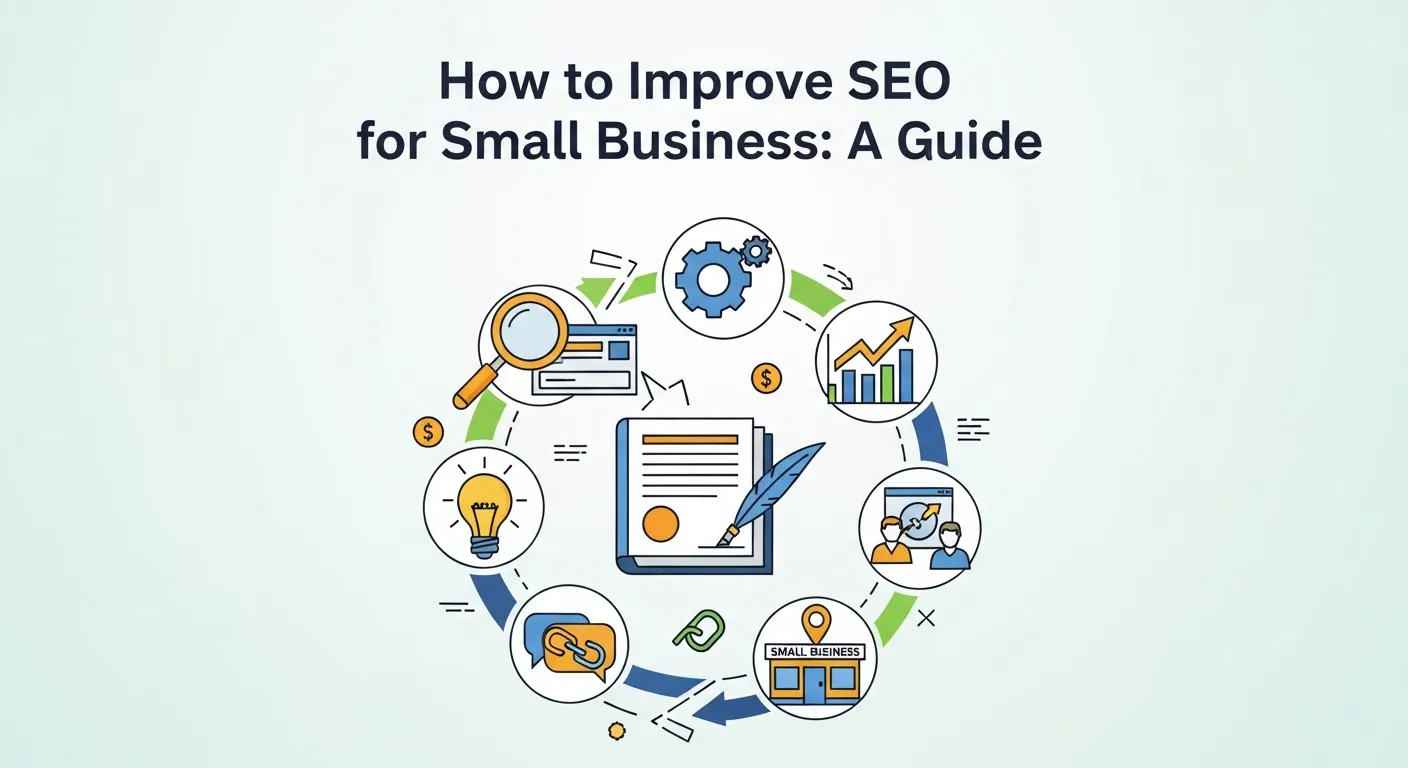
This guide explains how small businesses can improve SEO through keyword research, on-page optimization, technical fixes, local SEO, and content marketing. Consistent strategy, performance tracking, and avoiding common mistakes help increase visibility, traffic, and long-term growth.
Most small business owners know that having a website is essential for growth. Building an attractive site is just the first step. Getting people to actually find that site is an entirely different challenge. Search engine optimization provides a reliable way to attract organic traffic, connect with potential customers, and build lasting authority in your market.
SEO levels the playing field. It allows local shops, independent service providers, and niche startups to compete with massive corporations. By understanding exactly what your customers are searching for, you can position your business directly in their path right when they need your solutions. If you want to know how to improve SEO for small business, you must focus on specific strategies tailored to your market.
This guide covers everything you need to know about how to improve SEO for small business. We will explore fundamental concepts, keyword research strategies, technical requirements, and content marketing techniques. You will also learn how to measure your success, implement effective local SEO strategies, and avoid common pitfalls that keep small businesses hidden from search results.
The Evolving Landscape of Small Business SEO
Before diving into specific tactics on how to improve SEO for small business, it’s crucial to understand just how much the digital landscape has changed in the last few years. With Google’s constant algorithm updates and the rise of AI-powered search, being proactive—not reactive—is the golden rule for small business SEO tips.
Why SEO Matters More Than Ever
Even if you’re running a brick-and-mortar business, local SEO strategies are more critical than ever. Recent studies show that the majority of consumers look up a business online before making a purchase decision, with most searches happening on mobile devices. If your business doesn’t appear in search results, you’re missing out on valuable foot traffic and digital engagement.
- 97% of people learn more about a company online than anywhere else.
- Nearly half of all Google searches are for local information.
- 78% of local-mobile searches result in offline purchases.
Key SEO Terminology
Familiarizing yourself with a few core terms will make your SEO journey much smoother. To execute the best small business SEO tips, keep this vocabulary in mind:
|
Term |
Definition |
|---|---|
|
SERP |
Search Engine Results Page. The page displayed by a search engine in response to a user’s query. |
|
Ranking Factor |
Criteria applied by search engines when evaluating web pages to compile the rankings of their search results. |
|
Search Intent |
The primary goal a user has when searching a query. |
|
Backlink |
A link from one website to a page on another website, acting as a vote of confidence. |
|
Crawlability |
The ease with which search engine bots can access and index your website’s content. |
|
CTR (Click-Through Rate) |
The percentage of people who click on your link after seeing it in search results. |
|
Bounce Rate |
The percentage of visitors who navigate away from the site after viewing just one page. |
Keyword Research for Small Businesses

Keywords act as the bridge between what users are searching for and the content you provide. Proper keyword selection is vital when learning how to improve SEO for small business.
Identifying Your Target Audience and Niche
Effective keyword research starts with a deep understanding of your ideal customer. Think about the specific problems they are trying to solve. A local bakery should not just target the word “cake.” They need to focus on phrases like “custom birthday cakes near me” or “gluten-free cupcakes in Chicago.” Document the specific questions your customers ask you in person or over the phone. These questions form the basis of your local SEO strategies.
Deep Dive: Keyword Mapping and Content Clusters
One of the most advanced local SEO strategies is keyword mapping—organizing your keywords into clusters that match specific pages on your site. For each service or product you offer, create a unique set of target keywords. Then, structure your content around these clusters to establish topical authority, making it easier for search engines to connect your pages with relevant queries.
Tools for Keyword Research
You do not need to guess what people are typing into Google. Several tools can provide exact data on search volume and keyword difficulty. Google Keyword Planner is a free starting point if you have an Ads account. For deeper insights, premium tools allow you to spy on competitors and discover untapped keyword opportunities in your specific market. Incorporating these tools is one of the most effective small business SEO tips.
Other popular keyword research tools:
- Ahrefs
- SEMrush
- Ubersuggest
- Moz Keyword Explorer
Make a spreadsheet to organize keywords by theme, search volume, and difficulty. Use this as a living document to update your content plan as your business grows.
Long-Tail Keywords and Local SEO Keywords
Broad keywords are highly competitive. Small businesses should focus heavily on long-tail keywords. These are longer, more specific phrases that generally have lower search volume but much higher conversion rates. Someone searching for “buy waterproof hiking boots size 10” is much closer to making a purchase than someone just searching for “boots.” Combine these with local modifiers to capture high-intent local traffic as part of your local SEO strategies.
Local Keyword
|
Keyword Type |
Example Phrase |
Search Intent |
|---|---|---|
|
Broad/Short-Tail |
“bakery” |
General info, low intent |
|
Long-Tail |
“best vegan bakery near me” |
High commercial intent |
|
Location Modifier |
“birthday cakes in Downtown Houston” |
Local purchase intent |
|
Question-Driven |
“Where to buy gluten-free cupcakes?” |
Navigational/informational |
On-Page SEO Optimization Techniques

On-page SEO optimization refers to the optimizations you apply directly on your website’s pages to improve their search rankings. Mastering on-page SEO optimization is essential for anyone figuring out how to improve SEO for small business.
Website Structure and Navigation
A logical site structure helps both users and search engine crawlers find what they need. Group related content together into categories. Keep your navigation menu simple and ensure that any page on your site can be reached within three clicks from the homepage. A clean structure is a cornerstone of on-page SEO optimization.
Quick Check: Site Structure Tips
- Use breadcrumb navigation for user-friendly exploration.
- Create clear URL structures (example.com/services/seo-consulting/).
- Feature core products/services prominently on your homepage.
- Add an HTML sitemap for search engines.
Optimizing Page Titles and Meta Descriptions
Title tags and meta descriptions are the first things users see on a SERP. Your title tag should be compelling, accurately describe the page content, and include your primary keyword near the beginning. Meta descriptions do not directly impact rankings, but a well-written description improves your click-through rate. Proper meta tags represent a critical piece of on-page SEO optimization.
Example : Title Tag Optimization
|
Good Example |
Poor Example |
|---|---|
|
“Pet Grooming in Austin, TX |
Happy Tails Salon” |
|
“Affordable HVAC Repairs – Chicago Experts” |
“Home” |
Content Optimization and Formatting
Structure your written content using proper heading tags (H1, H2, H3). Your H1 is your main headline, while H2s and H3s break up subtopics. Weave your target keywords naturally into the body text, avoiding the temptation to force them where they do not belong. Add descriptive Alt text to all your images. Excellent content formatting elevates your overall on-page SEO optimization strategy.
On-Page SEO Checklist
- Include your focus keyword in the first 100 words.
- Use bullet points or numbered lists for readability.
- Add for each page at least one relevant internal link.
- Optimize images with descriptive Alt attributes.
- Use schema markup where possible.
Advanced On-Page SEO Optimization
For those seeking to take their on-page SEO optimization to the next level, consider the following small business SEO tips:
Schema Markup for Enhanced Visibility
Add schema to highlight reviews, products, FAQs, and events. Schema markup improves the way your pages are displayed in search results—think of star ratings, price ranges, or “in-stock” notifications—driving a higher click-through rate.
Featured Snippets and Zero-Click Searches
Write succinct answers to common customer questions in paragraph, list, or table format. Optimizing for featured snippets increases your chances of appearing at the top of the SERPs (“position zero”), driving organic clicks and brand authority.
Technical SEO Essentials
Technical SEO ensures that search engines can easily crawl and index your website without encountering technical roadblocks. Implementing these small business SEO tips ensures your foundation is strong.
Deep Crawlability and Indexation
Check for crawl errors using Google Search Console. Create an XML sitemap and update it regularly. Test your robots.txt to prevent search engines from missing important pages.
Technical SEO Priority List
|
Priority |
Task |
Tool |
|---|---|---|
|
High |
Mobile-friendly design |
Google Mobile Test |
|
High |
SSL certificate (HTTPS) |
SSL Checker |
|
Medium |
Resolve crawl errors |
Search Console |
|
Medium |
Generate & submit XML sitemap |
Various plugins |
|
Low |
Check 404 errors and fix broken links |
Site Audit Tools |
Website Speed and Core Web Vitals
Site speed is now a direct Google ranking factor. Compress images, use a reliable hosting provider, and reduce unnecessary plugins or scripts. Monitor Core Web Vitals—which include Largest Contentful Paint (LCP), First Input Delay (FID), and Cumulative Layout Shift (CLS)—and fix any issues flagged in Google Search Console.
Accessibility and User Experience
Sites that are accessible to all users (including those who use screen readers) not only meet legal requirements but also rank better, as Google prioritizes usability. Use strong color contrasts, add Alt text to all images, and ensure that font sizes and clickable elements are easy to access on all devices.
Off-Page SEO and Google My Business Optimization

Off-page SEO involves actions taken outside of your own website to impact your rankings. A major pillar for regional companies is executing effective local SEO strategies and Google My Business optimization.
Building High-Quality Backlinks
When a reputable website links to yours, search engines view it as a vote of confidence. Focus on earning links from local directories, industry publications, and local news outlets. You can sponsor local events, partner with complementary businesses, or reach out to bloggers in your niche to secure these valuable backlinks.
Leveraging Citations for Local SEO Strategies
Submit your business name, address, and phone number (NAP) to reputable business directories, chamber of commerce sites, and industry-specific listings. Consistency in NAP is fundamental for local SEO strategies as it builds trust with Google and other search engines.
Mastering Google My Business Optimization
For a small, geographically-bound business, Google My Business optimization is arguably your most important SEO asset. Claim and verify your listing immediately. Fill out every single field, add high-quality photos regularly, and actively encourage satisfied customers to leave reviews.
If you need a refresher on the basics, you can read more about what Google My Business is to fully leverage the platform. Google My Business optimization drives map rankings and local pack features, making it the most vital part of your local SEO strategies.
- Post updates and offers regularly.
- Respond to all customer reviews—positive or negative.
- Update business hours and service areas.
Content Marketing for SEO
Publishing helpful, high-quality content is the most sustainable way to attract search traffic over time. This supports all your other small business SEO tips and on-page SEO optimization efforts.
Creating Valuable and Engaging Content
Content marketing is about answering your customers’ questions. Address their pain points, educate them about your industry, and provide actionable advice. If you run a landscaping company, write a detailed guide on the best native plants for your specific climate. Valuable content naturally earns backlinks and keeps users on your site longer.
Content Calendar Planning
Maintain a content calendar for articles, guides, infographics, videos, and case studies. Plan keyword-driven content in advance based on seasonality, promotions, or recurring customer questions.
Sample Content Calendar
|
Month |
Topic/Keyword |
Format |
Goal |
|---|---|---|---|
|
January |
“How to improve SEO for a small business.” |
Blog Post |
Educational/lead generation |
|
February |
“Valentine’s gifts from local shops” |
Social Media |
Seasonal traffic/engagement |
|
March |
“Local SEO strategies for service pros” |
Guide |
Authority building |
Diversifying Content Formats
Diversify your content formats. Regularly updated blog posts are excellent for targeting long-tail keywords. Comprehensive pillar guides establish your authority on broad topics. Video content is highly engaging and can be optimized for both YouTube search and Google search. Embed relevant videos directly into your written articles to boost engagement.
Content Promotion Tips
- Share new blog posts on all social media platforms.
- Send major content pieces via your email newsletter.
- Collaborate with other local businesses to co-create content (e.g., interviews, case studies).
Measuring and Analyzing SEO Performance
You cannot improve what you do not measure. Tracking your efforts ensures you are getting a return on your investment when determining how to improve SEO for a small business.
Utilizing Analytics Tools
Google Analytics is a free tool that tracks website traffic and user behavior. It shows you exactly how many people are visiting your site and which channels they are coming from. Google Search Console provides direct communication between your website and Google. It alerts you to indexing errors and shows you exactly which search queries are driving traffic to your site.
Setting up SEO Dashboards
Custom dashboards—in Google Data Studio or third-party analytics tools—help you visualize your traffic, sources, keyword positions, and conversion goals. Set clear benchmarks and track performance against your objectives.
Tracking Keyword Rankings
Monitor your keyword rankings over time to see if your optimization efforts are working. Specialized rank trackers can automate this process. Keep in mind that search rankings fluctuate daily. Look for long-term trends rather than stressing over daily drops or spikes.
Common SEO Mistakes to Avoid
Many small businesses unknowingly sabotage their own SEO efforts. Steer clear of these common errors to ensure your local SEO strategies actually work.
- Keyword Stuffing: Shoving your target keyword into a sentence as many times as possible makes your content unreadable and can result in search engine penalties. Write naturally for humans first.
- Duplicate Content: Search engines get confused when they find identical content on multiple pages of your site, or copied from another website entirely. Ensure every page on your website provides unique, original value.
- Ignoring Mobile Optimization: A beautiful desktop site is useless if it is un navigable on a smartphone. Regularly test your site on different devices to identify and fix layout issues.
- Neglecting Technical SEO: Failing to fix crawl errors, submit sitemaps, or secure your site with HTTPS can derail otherwise strong SEO strategies.
- Not Analyzing Competitors: Regularly audit top competitors to see what keywords and content formats are working for them.
Taking Action: Building an SEO Roadmap
Success comes from consistent action on all fronts—on-page SEO optimization, Google My Business optimization, technical fixes, content creation, and link building. Create a spreadsheet or project board with monthly, quarterly, and annual SEO goals. Celebrate small milestones, like hitting a new traffic high or ranking for a competitive keyword. Remember, the best way to learn how to improve SEO for a small business is to do the work, measure results, and adapt as you go.
Frequently Asked Questions (FAQ)
How long does it take to see results from SEO?
SEO is a long-term strategy that typically takes three to six months to show noticeable results. The timeline depends heavily on your competition, the current state of your website, and how aggressively you apply on-page SEO optimization. Consistent effort yields the best compounding returns over time.
What are the most important local SEO strategies?
The most vital local SEO strategies include creating locally focused content, building local citations in directories, and managing customer reviews. Google My Business optimization is also critical, as it directly dictates how your business appears in Google Maps and local search results.
How do I start with Google My Business optimization?
Begin your Google My Business optimization by claiming your profile and ensuring your Name, Address, and Phone number (NAP) are exactly correct. Upload high-quality photos of your storefront, add a detailed description of your services, and regularly post updates to keep the profile active.
Are backlinks really that important for small businesses?
Yes, backlinks remain one of the strongest ranking factors for search engines. They act as digital referrals that prove your website is trustworthy and authoritative. For small businesses, earning links from local newspapers or community organizations provides a massive boost to search visibility.
What exactly is on-page SEO optimization?
On-page SEO optimization involves tweaking the elements on your own website, such as meta tags, headers, URL structures, and internal links. It ensures that search engine crawlers can easily understand your content and index it for the appropriate search queries.
Can I do my own SEO or should I hire an agency?
You can absolutely implement basic small business SEO tips yourself, especially content creation and Google My Business optimization. However, as your business grows, hiring an agency can help you tackle complex technical SEO issues and large-scale link-building campaigns that require specialized software.
How often should I publish new content?
You should aim to publish high-quality, relevant content at least once or twice a month to keep your site fresh. Consistency matters more than extreme volume. Focus on writing comprehensive articles that genuinely help your audience rather than churning out thin, unhelpful posts.
Why is mobile-friendliness considered an SEO ranking factor?
Google uses mobile-first indexing because the majority of global internet users search from mobile devices. If your site offers a poor mobile experience, users will bounce quickly, sending a negative signal to Google. Responsive design is a non-negotiable part of modern website management.
What are some advanced small business SEO tips I should know?
Once you cover the basics, you should focus on improving your site speed, implementing schema markup for local businesses, and conducting deep competitor keyword gap analysis. You can explore these 10 essential SEO tips to find more advanced tactics to outrank your competitors.
How do I know if my SEO strategy is actually working?
You can measure SEO success by tracking organic traffic growth in Google Analytics and monitoring your average position in Google Search Console. Additionally, track the number of leads, calls, or sales that originate from organic search to ensure your traffic is actually converting into revenue.
By following this in-depth guide on how to improve SEO for small business and mixing in personalized strategies that fit your industry, you can boost your site’s visibility, attract more customers, and drive continual growth—no matter how tough the competition is.
