


HTML schema improves SEO by helping search engines understand content meaning, enabling rich results, higher click-through rates, and better visibility. This guide explains types, formats, implementation steps, benefits, and best practices for structured data success.
HTML schema has quietly become one of the most powerful tools in modern search engine optimization. It works behind the scenes, helping search engines understand exactly what your content means, not just what words appear on the page. When you add HTML schema to your site, you give search engines a clear map of your information. That clarity often leads to richer search results, higher click-through rates, and a stronger presence online.
This guide walks you through everything you need to know about HTML schema. We’ll explore what it is, how it works, the different formats available, and why JSON-LD has become the recommended choice. You’ll find a step-by-step implementation walkthrough, a handy comparison table, practical tips, and answers to the questions people ask most. Whether you’re a beginner or a seasoned developer, this resource will help you master structured data. Let’s dive in and unlock the full potential of HTML schema for your website.
What Is HTML Schema?
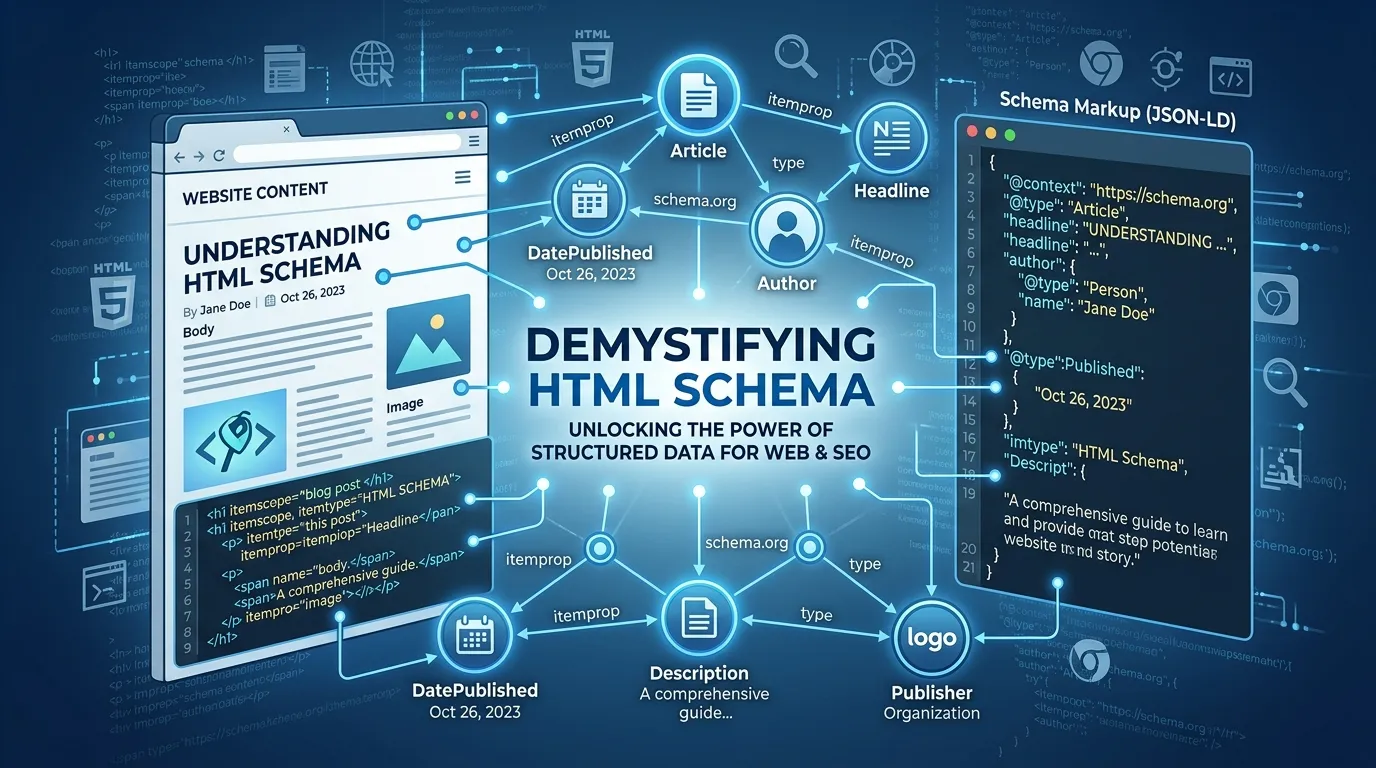
HTML schema is a form of structured data that helps search engines understand the meaning and context of your web content. Instead of leaving search engines to guess what a page is about, schema spells it out clearly. It labels your content with specific tags that describe people, products, events, reviews, recipes, and much more. This shared vocabulary makes your pages easier to read and interpret.
The term comes from Schema.org, a collaborative project backed by Google, Microsoft, Yahoo, and Yandex. These major search engines agreed on a single vocabulary so that everyone speaks the same language. When you use HTML schema, you tap into that shared standard. Your content becomes machine-readable in a way that plain text simply cannot match.
Think of HTML schema as a translator between your website and search engines. Humans read your page and understand it naturally. Machines, however, need extra help to grasp context and relationships. Schema markup provides that help, turning ordinary content into clearly defined, structured information that search engines can trust and reward.
The Difference Between Content and Meaning
A web page full of text tells a human plenty. We read a price, a name, or a date and instantly know what it means. Search engines don’t have that intuition built in. They see strings of characters without inherent context. HTML schema bridges this gap by adding meaning to the raw content.
For example, the number “4.8” could mean anything on its own. With schema, you can tell search engines it’s a star rating out of five. Suddenly, that number carries real meaning. This is the core purpose of Schema Markup: turning ambiguous data into clear, labeled information that machines understand perfectly.
Why HTML Schema Matters for Modern Websites
Search engines grow smarter every year, but they still rely on clear signals. HTML schema gives them the strongest signals possible about your content. Sites that use structured data often stand out in search results with extra visual features. These enhancements catch the eye and draw more clicks.
Beyond visibility, schema supports the broader goals of Website SEO Optimization. It helps your pages qualify for rich results, voice search answers, and knowledge panels. As search evolves toward AI-driven experiences, structured data becomes even more valuable. Adopting HTML schema now prepares your site for the future of search.
How Schema Markup Works
Schema markup works by embedding special code into your web pages that describes the content in a structured way. This code doesn’t change how your page looks to visitors. Instead, it operates quietly in the background, feeding information to search engine crawlers. When a crawler visits your page, it reads this markup and builds a clear understanding of your content.
The process relies on a system of types and properties. A “type” describes the kind of thing you’re marking up, such as an article, a product, or a business. Each type comes with “properties” that add detail, like an author name, a price, or an address. Together, types and properties create a rich, organized description of your content.
Once search engines process this structured data, they can use it in powerful ways. They may display your content as a rich result with stars, images, or extra details. They might pull your data into a knowledge panel or use it to answer a voice query. The clearer your HTML schema, the more opportunities your content earns.
Types and Properties Explained
Every piece of schema starts with a type. This tells search engines the category of your content. Schema.org offers hundreds of types covering nearly every kind of information you can imagine. Choosing the right type is the foundation of good Schema Markup.
Properties add the specific details within each type. For instance, an “Article” type might include properties for the headline, author, publish date, and featured image. These properties turn a broad category into a precise description. The more accurate and complete your properties, the better search engines understand your page.
The Role of Schema.org Vocabulary
Schema.org acts as the central dictionary for all structured data. It defines every type and property in a consistent, standardized way. Because all major search engines support it, using this vocabulary guarantees broad compatibility. You never have to worry about one engine ignoring your markup.
This shared standard also keeps things simple for you. Instead of learning separate systems for each search engine, you learn one. That single vocabulary powers HTML schema across the entire web. It’s the reason structured data has become so widely adopted and so reliable for Structured Data SEO.
The Three Main Types of Schema Formats
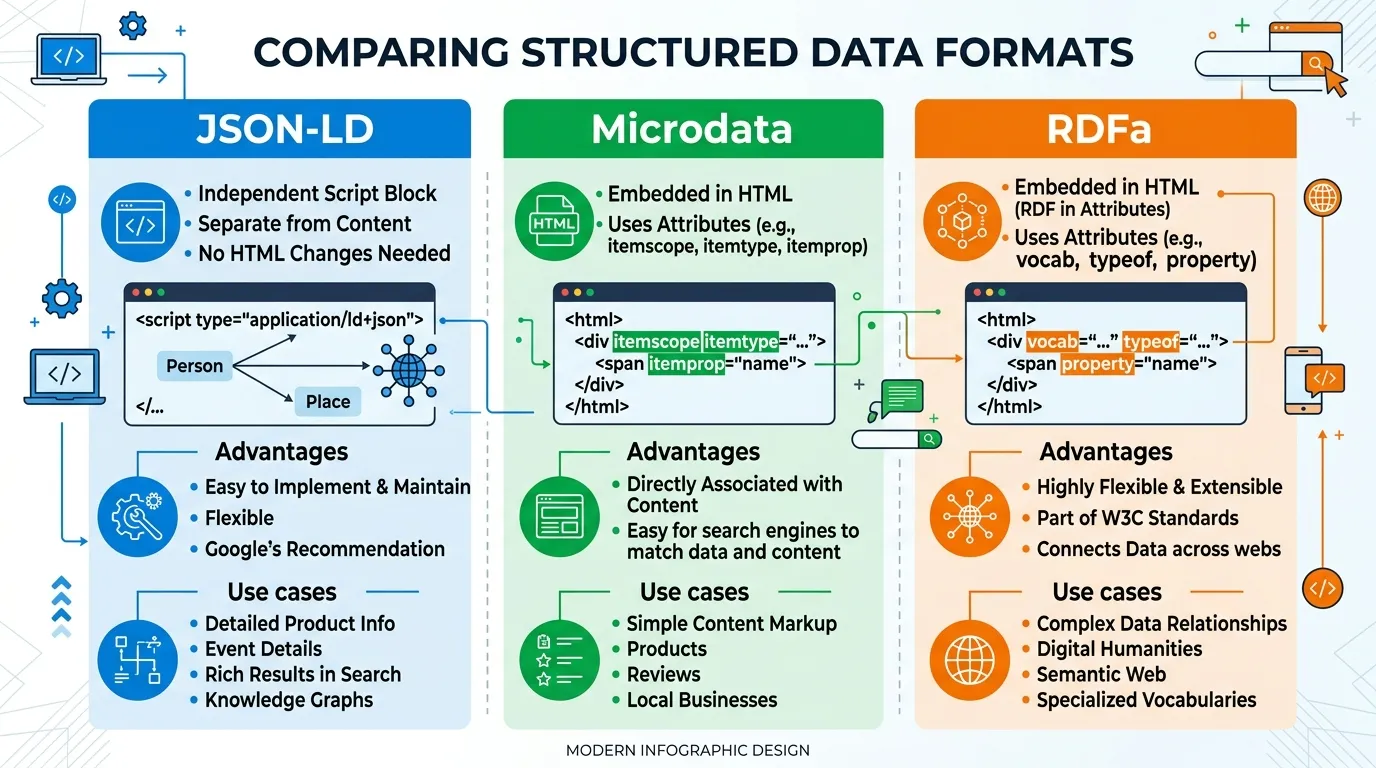
You can add HTML schema to your pages using three different formats. Each achieves the same goal but uses a different method. Understanding these options helps you choose the best approach for your site. Let’s break down each format and see how they compare.
The three formats are JSON-LD, Microdata, and RDFa. They all rely on the Schema.org vocabulary, so the underlying meaning stays the same. The difference lies in how the code is written and where it sits within your page. Some formats mix into your visible HTML, while others stay neatly separated.
Choosing a format matters because it affects how easy your schema is to maintain. A cleaner, simpler format saves you time and reduces errors. It also influences how smoothly you can update your markup as your content changes. Below, we explore each option in detail.
JSON-LD Schema
JSON-LD stands for JavaScript Object Notation for Linked Data. It’s a script-based format that lives in a separate block within your page’s HTML. Because it stays apart from your visible content, it keeps your code clean and organized. You simply add a script tag containing all your structured data.
This separation is a huge advantage. You don’t have to weave markup through your existing HTML elements. Instead, you write one tidy block that describes everything. JSON-LD Schema has become the favorite of developers and search engines alike for exactly this reason. It’s flexible, readable, and easy to manage.
Microdata
Microdata takes a different approach by embedding schema directly into your HTML tags. You add special attributes to your existing elements to describe them. This means your markup lives inline with your visible content. Each piece of data gets wrapped in tags that carry schema attributes.
While Microdata works well, it can clutter your HTML quickly. Mixing structure and content makes your code harder to read and update. For simple pages, it remains a valid choice. However, many developers now prefer the cleaner separation that JSON-LD offers for their Website SEO Optimization efforts.
RDFa
RDFa, or Resource Description Framework in Attributes, also embeds schema within your HTML. Like Microdata, it uses attributes added to existing tags. It’s an extension of HTML5 and supports a wide range of vocabularies beyond Schema.org. This flexibility appeals to some advanced users.
However, RDFa shares the same drawback as Microdata. Blending markup into your content can make maintenance tricky. It also tends to be more complex to write correctly. For most websites focused on Structured Data SEO, simpler formats deliver the same benefits with far less hassle.
Why JSON-LD Schema Is the Recommended Format
Among the three formats, JSON-LD schema stands out as the clear winner for most websites. Google itself recommends it as the preferred way to add structured data. This endorsement alone makes it worth serious consideration. But the reasons behind that recommendation go much deeper than a simple preference.
The biggest advantage is separation. JSON-LD sits in its own script block, completely apart from your visible HTML. This keeps your page code clean and your content untouched. You can add, edit, or remove schema without ever disturbing your actual page layout. That freedom makes maintenance a breeze.
JSON-LD also plays nicely with modern web development. It works smoothly with content management systems, tag managers, and dynamic sites. You can inject it through JavaScript or add it through plugins with ease. For anyone serious about Website SEO Optimization, JSON-LD Schema offers the best mix of power and simplicity.
If you want a beginner-friendly deep dive into writing and understanding this format, one resource stands out as especially helpful. Read this beginner’s guide to JSON-LD structured data:
JSON-LD for Beginners
Studying a clear, well-explained guide accelerates your learning dramatically. It shows real examples and walks you through the syntax step by step. Pairing that knowledge with the tips in this article gives you a strong foundation. Soon, writing JSON-LD Schema will feel natural and effortless.
Key Advantages of JSON-LD
JSON-LD brings several practical benefits that make it the top choice. These advantages explain why so many developers and SEO experts rely on it. Consider the following strengths when planning your HTML schema strategy.
- Clean separation: Your markup stays in one block, keeping HTML tidy.
- Easy maintenance: Update schema without touching visible content.
- Google recommended: The preferred format for search engine crawlers.
- CMS friendly: Works seamlessly with plugins and tag managers.
- Dynamic support: Injects easily through JavaScript on modern sites.
These strengths add up to a smoother, more reliable experience. You spend less time wrestling with code and more time improving your content. That efficiency is exactly why JSON-LD dominates the world of Structured Data SEO today.
When Other Formats Still Make Sense
Despite JSON-LD’s dominance, other formats occasionally have their place. Some older systems or templates may already use Microdata. In those cases, keeping the existing format can save time. Rewriting everything isn’t always worth the effort if your current setup works.
RDFa may suit projects that require vocabularies beyond Schema.org. Its extra flexibility serves specialized needs. Still, for the vast majority of websites, JSON-LD remains the smartest starting point. It delivers the benefits of HTML schema with the least friction and the greatest support.
The SEO Benefits of Structured Data
Structured data SEO offers a range of powerful benefits that go far beyond simple rankings. While schema itself isn’t a direct ranking factor, it influences many things that matter deeply. It shapes how your content appears, how users interact with it, and how search engines understand it. These effects combine to boost your overall performance.
The most visible benefit is eligibility for rich results. These enhanced listings include stars, images, prices, and other eye-catching details. They make your result stand out in a crowded page of blue links. That extra visibility naturally draws more clicks and more traffic to your site.
Beyond appearance, structured data helps search engines trust your content. Clear, accurate markup signals professionalism and organization. It also supports emerging search features like voice answers and AI summaries. Investing in HTML schema future-proofs your site as search technology keeps advancing.
Higher Click-Through Rates
Rich results simply look more appealing than plain listings. When your result shows star ratings or a product image, it grabs attention instantly. Users are drawn to these visual cues and click them more often. This lift in click-through rate can significantly boost your traffic.
More clicks also send positive signals to search engines. When people consistently choose your result, it suggests your content is valuable. Over time, this behavior can support better positioning. That’s the quiet, compounding power of good Schema Markup working in your favor.
Better Content Understanding
Search engines want to serve the most relevant results possible. To do that, they must truly understand each page. HTML schema hands them that understanding on a silver platter. It removes guesswork and clarifies exactly what your content offers.
This clarity helps your pages match the right searches more accurately. When search engines know your page is a recipe, a review, or an event, they serve it to the right people. Better matching means more qualified traffic. That precision is a cornerstone of effective Structured Data SEO.
Support for Voice Search and AI
Voice assistants and AI-powered search rely heavily on structured data. When someone asks a question aloud, the assistant needs a clear, direct answer. Schema helps supply that answer by organizing your information neatly. Well-marked pages often become the source for these spoken responses.
As AI reshapes how people find information, this benefit grows more important. Structured data feeds the systems that generate summaries and answers. Sites with strong HTML schema position themselves to be featured. Preparing now keeps you ahead as search continues to evolve.
Common Types of Schema Markup
Schema.org offers hundreds of types, but a handful cover most real-world needs. Knowing these common types helps you choose the right markup for each page. Applying the correct type ensures search engines interpret your content accurately. Let’s explore the most useful schema types you’ll likely use.
Each type serves a specific kind of content. An article uses different properties than a product or an event. Matching the type to your content is essential for success. Using the wrong type confuses search engines and can even trigger errors. Precision pays off here.
The good news is that these common types cover the vast majority of websites. Whether you run a blog, a shop, or a local business, there’s a perfect type waiting. Below, we break down the ones you’ll turn to most often in your HTML schema work.
Article Schema
Article schema suits blog posts, news stories, and editorial content. It tells search engines the headline, author, publish date, and featured image. This helps your content appear properly in news carousels and top stories features. It’s essential for any content-focused website.
Adding article schema improves how your posts display in search. It can unlock rich features that make your listing more attractive. For bloggers and publishers, this type is a must-have. It forms the backbone of content-driven Website SEO Optimization.
Product Schema
Product schema is vital for online stores and ecommerce sites. It describes a product’s name, price, availability, and reviews. When applied correctly, it can display prices and star ratings right in search results. This makes your listings far more compelling to shoppers.
These enhanced results often boost both clicks and conversions. Shoppers love seeing key details before they even click. Product schema gives them that information upfront. For ecommerce, it’s one of the most valuable pieces of Schema Markup you can implement.
FAQ Schema
FAQ schema marks up frequently asked questions and their answers. When used well, it can display those questions directly in search results. This expands your listing and answers user queries instantly. It also takes up more space on the results page, pushing competitors down.
This type works beautifully on support pages, product pages, and guides. It gives users quick answers while boosting your visibility. FAQ schema is a simple yet effective way to enhance your presence. It rewards clear, helpful content with extra search real estate.
LocalBusiness Schema
LocalBusiness schema is essential for physical stores and service providers. It describes your business name, address, phone number, hours, and location. This helps you appear in local searches and map results. For local companies, it’s absolutely critical.
Accurate local schema helps customers find and contact you easily. It powers the rich local listings that appear for “near me” searches. Getting these details right strengthens your local presence. It’s a key part of Structured Data SEO for any location-based business.
Other Useful Schema Types
Beyond the main types, several others serve specific needs. Choosing the right one depends entirely on your content. Here are a few more valuable types worth knowing.
- Recipe schema: Displays cooking times, ratings, and ingredients for food content.
- Event schema: Shows dates, locations, and ticket info for upcoming events.
- Review schema: Highlights ratings and opinions about products or services.
- Video schema: Enhances video content with thumbnails and durations.
- Breadcrumb schema: Clarifies your site structure within search results.
These types expand your options across many content categories. Each unlocks unique rich result features. Matching them thoughtfully to your pages maximizes your HTML schema impact across the whole site.
How to Implement HTML Schema Step by Step
Adding HTML schema to your site may sound technical, but the process is straightforward. With a clear plan, anyone can do it successfully. Following these steps ensures your markup is accurate, valid, and effective. Let’s walk through the process from start to finish.
The key is to work methodically. Rushing leads to errors that can hurt rather than help. Take each step carefully, test your work, and verify the results. This disciplined approach guarantees your schema does its job well. Soon, adding markup will become a routine part of your workflow.
Remember that quality matters more than quantity. It’s better to have a few accurate schema types than many broken ones. Focus on marking up your most important content first. Then expand gradually as you grow comfortable with the process.
Step One: Choose the Right Schema Type
Start by identifying what kind of content you’re marking up. Is it an article, a product, an event, or a local business? Choosing the correct type is the foundation of everything else. The wrong choice leads to confusion and errors.
Visit Schema.org to browse the available types if you’re unsure. Read the descriptions and match them to your content carefully. Picking the right type sets your HTML schema up for success. This first decision shapes all the properties you’ll add next.
Step Two: Gather Your Content Details
Once you’ve chosen a type, collect all the relevant details. For an article, that means the headline, author, date, and image. For a product, gather the name, price, availability, and reviews. Having this information ready makes writing your schema much smoother.
Accuracy is crucial here. Your markup must match the visible content on your page exactly. Mismatched data can trigger penalties or errors. Double-check every detail before you proceed. Clean, honest data is the heart of good Schema Markup.
Step Three: Write Your JSON-LD Code
Now it’s time to write your JSON-LD Schema. Create a script block and fill it with your chosen type and properties. Follow the correct syntax carefully, paying attention to brackets and commas. Even small mistakes can break your markup.
If writing code feels daunting, use a schema generator tool. These tools let you fill in fields and produce the code for you. They’re perfect for beginners and save plenty of time. Once generated, you simply copy the code into your page.
Step Four: Add the Schema to Your Page
Place your JSON-LD script block into your page’s HTML, ideally in the head or body section. Because JSON-LD stays separate from your content, this step is clean and simple. You don’t need to alter any visible elements.
If you use a content management system, plugins can handle this for you. Many SEO tools add schema automatically based on your input. Choose the method that fits your setup best. Either way, the goal is to get valid markup onto your live page.
Step Five: Test and Validate
Never assume your schema works without testing it. Use validation tools to check your markup for errors. These tools show you exactly what search engines see. They flag mistakes so you can fix them before they cause problems.
Testing is a vital step you should never skip. It confirms your HTML schema is correct and eligible for rich results. Run every page through a validator after adding markup. This habit protects your Website SEO Optimization and ensures reliable results.
Comparing Schema Formats and Their Uses
To help you choose the right approach, here’s a comparison of the three schema formats. The table below highlights their key traits across important factors. Use it as a quick reference when planning your HTML schema strategy. Seeing them side by side makes the choice much clearer.
|
Format |
Placement |
Ease of Use |
Maintenance |
Best For |
|---|---|---|---|---|
|
JSON-LD |
Separate script block |
Very easy |
Simple to update |
Most websites and modern sites |
|
Microdata |
Inline within HTML tags |
Moderate |
Harder to update |
Simple, static pages |
|
RDFa |
Inline within HTML tags |
Complex |
Harder to update |
Advanced, specialized needs |
This comparison makes the advantages of JSON-LD clear. Its clean separation and easy maintenance beat the inline formats for most uses. The gains in simplicity and reliability explain why it dominates today. For nearly every project, JSON-LD Schema is the smart default choice.
Reading the Table for Your Project
Look at your website’s needs and technical setup. If you want the easiest, most reliable option, JSON-LD wins hands down. It suits blogs, shops, and complex dynamic sites equally well. Its flexibility handles almost any situation you throw at it.
Consider the inline formats only in specific cases. If you inherit an existing Microdata setup, keeping it may save effort. If you need vocabularies beyond Schema.org, RDFa offers that reach. Otherwise, matching your project to JSON-LD keeps your Structured Data SEO clean and future-ready.
How Schema Affects Rich Results
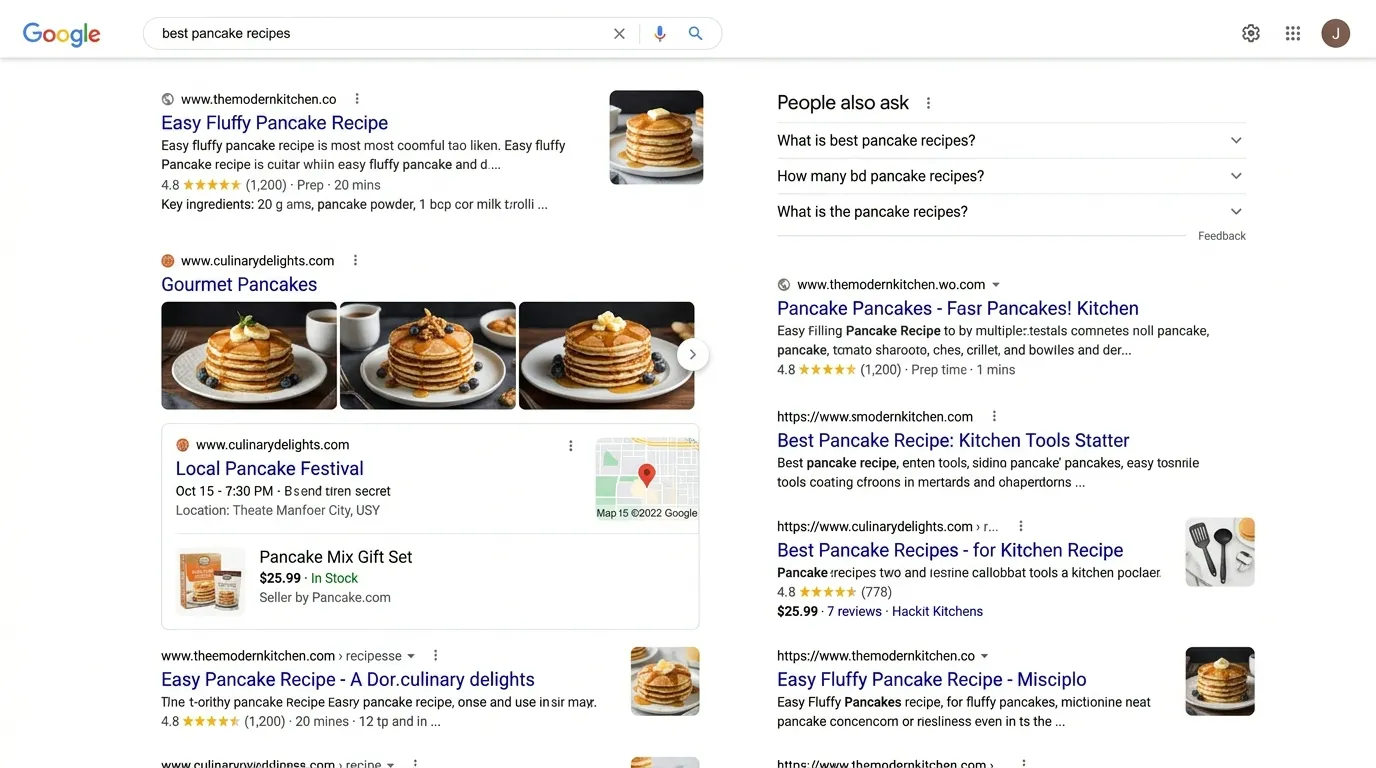
Rich results are the enhanced search listings that make schema so exciting. They transform a plain link into an eye-catching feature packed with useful details. HTML schema is what makes these rich results possible. Without structured data, your listings stay basic and easy to overlook.
Search engines use your markup to decide what enhancements to display. A product page with proper schema might show a price and star rating. A recipe page could display cooking time and a photo. These features draw attention and communicate value before a user even clicks.
However, eligibility doesn’t guarantee display. Search engines choose when to show rich results based on many factors. Your job is to provide accurate, complete schema that qualifies your pages. Doing so maximizes your chances of earning these valuable enhancements.
Types of Rich Results
Rich results come in many forms, each tied to specific schema types. Knowing them helps you target the features you want. Here are some common rich results you can pursue with HTML schema.
- Review snippets: Star ratings that appear beneath your listing.
- Product results: Prices, availability, and ratings for items.
- FAQ results: Expandable questions and answers in the listing.
- Recipe cards: Images, ratings, and cooking times for dishes.
- Event listings: Dates, times, and locations for upcoming events.
Each of these features makes your listing more useful and attractive. They give users answers upfront and encourage clicks. Targeting the right ones for your content boosts your visibility. This is where Schema Markup truly shines in practice.
Maximizing Your Rich Result Chances
To earn rich results consistently, focus on accuracy and completeness. Fill in all recommended properties for your chosen schema type. Missing required fields disqualifies your pages instantly. Thorough markup gives you the best possible shot.
Also keep your schema aligned with your visible content. Search engines penalize markup that misleads or exaggerates. Honesty and precision protect your eligibility over time. Consistent, high-quality HTML schema keeps your rich results flowing steadily.
Tools for Testing and Validating Schema Markup
Testing your markup is one of the most important steps in the entire process. Even a tiny syntax error can break your schema completely. Fortunately, several excellent tools make validation quick and painless. Using them regularly keeps your HTML schema accurate and effective.
These tools show you exactly how search engines interpret your markup. They highlight errors, warnings, and missing properties. This feedback lets you fix problems before they harm your visibility. Never publish schema without running it through a validator first.
Building testing into your routine prevents countless headaches. It catches mistakes early and confirms your eligibility for rich results. Think of validation as quality control for your Structured Data SEO. A few minutes of testing saves hours of troubleshooting later.
Schema Validation Tools
Several reliable tools help you check your markup thoroughly. Each offers slightly different features, so many people use more than one. Here are the essential tools worth adding to your toolkit.
- Rich Results Test: Shows which rich results your page qualifies for.
- Schema Markup Validator: Checks your code against Schema.org standards.
- Structured Data testing tools: Reveal errors and warnings in your markup.
- Browser extensions: Let you inspect schema on any page instantly.
- CMS plugins: Validate and manage schema within your website dashboard.
These tools together cover every testing need you’ll encounter. They make validation simple even for beginners. Running your pages through them regularly keeps your markup clean. Reliable testing is the secret to consistent Website SEO Optimization success.
Fixing Common Errors
When a tool flags an error, don’t panic. Most issues are simple to fix once you understand them. Common problems include missing required properties, incorrect syntax, or mismatched data. Read the error message carefully to pinpoint the cause.
Correct the issue, then re-test your page to confirm the fix. Repeat this cycle until your markup passes cleanly. This methodical approach resolves nearly every problem. Patient testing and fixing keep your HTML schema healthy and fully functional.
Best Practices for Website SEO Optimization With Schema
Applying schema well requires more than just adding code. Following proven best practices ensures your markup delivers maximum value. These habits keep your structured data accurate, compliant, and effective. Adopt them to get the most from your HTML schema efforts.
The overarching principle is honesty and accuracy. Your markup must reflect your visible content faithfully. Search engines reward truthful structured data and punish deception. Building your strategy on this foundation protects your site long term.
Consistency also matters greatly. Apply schema thoughtfully across your important pages. Keep it updated as your content changes. A well-maintained schema strategy compounds its benefits over time. These best practices turn good intentions into lasting results.
Keep Markup Accurate and Honest
Always mark up content that actually appears on the page. Never add schema for information users can’t see. This misleading practice violates search engine guidelines and risks penalties. Honesty is non-negotiable in structured data.
Match every property to your real content exactly. If your page shows a four-star rating, your schema must say four stars. This alignment builds trust with search engines. Accurate Schema Markup keeps your pages eligible and your reputation intact.
Use JSON-LD Whenever Possible
For most situations, JSON-LD is the best format to choose. Its clean separation and easy maintenance make it ideal. Google recommends it, and it works across nearly every platform. Defaulting to JSON-LD Schema simplifies your entire workflow.
Reserve other formats for special cases only. Unless you have a specific reason to use Microdata or RDFa, stick with JSON-LD. This consistency keeps your code tidy and your maintenance simple. It’s the smartest path for long-term Structured Data SEO.
Focus on High-Value Pages First
You don’t need to add schema to every single page at once. Start with your most important content. Product pages, key articles, and local business info deliver the biggest wins. Prioritizing these pages maximizes your early results.
Once your priority pages are marked up and tested, expand gradually. Move to secondary pages over time. This phased approach keeps the work manageable. It also lets you learn and refine your process as you go.
Keep Schema Updated
Your content changes over time, and your schema should too. Outdated markup can mislead search engines and users. Whenever you update prices, dates, or details, update your schema to match. Fresh, accurate data protects your rich results.
Regular audits help you catch outdated markup. Schedule periodic reviews of your key pages. Fix any mismatches or errors you find. This ongoing care keeps your HTML schema working hard for your Website SEO Optimization.
Avoid Over-Marking Your Pages
More schema isn’t always better. Adding excessive or irrelevant markup can confuse search engines. Stick to schema that genuinely describes your content. Quality and relevance beat sheer quantity every time.
Focus on the types that match your page’s true purpose. Resist the urge to stuff pages with unrelated schema. Clean, focused markup performs best. Thoughtful restraint is a hallmark of expert HTML schema work.
The Future of HTML Schema and Structured Data
Structured data keeps growing more important as search technology advances. What began as a simple way to enhance listings now powers cutting-edge features. HTML schema sits at the center of this evolution. Understanding where it’s headed helps you prepare for what’s next.
Search is shifting toward AI-driven experiences and conversational answers. These systems depend heavily on clear, structured information. Schema feeds them the organized data they need. Sites with strong markup will thrive in this new landscape. Those without it risk falling behind.
The trend is clear: structured data will only become more valuable. Investing in HTML schema today builds a foundation for tomorrow. As new schema types and features emerge, well-prepared sites adapt easily. Staying current keeps you ahead of the curve in a fast-changing field.
Schema and AI-Powered Search
AI search tools generate answers by pulling from trusted, structured sources. HTML schema makes your content one of those reliable sources. When your data is clearly labeled, AI systems can use it confidently. This positions your site to be featured in AI-generated responses.
As these tools grow more popular, the advantage grows too. Sites with rich structured data become go-to sources for answers. This visibility drives traffic and builds authority. Embracing JSON-LD Schema now prepares you for this AI-driven future.
Evolving Schema Types and Features
Schema.org continues to expand its vocabulary regularly. New types and properties appear to cover emerging content categories and technology. Staying aware of these additions helps you stay current. Early adopters of new schema types often gain a head start in rich results.
Watch Schema.org and major SEO blogs for announcements about new types. When a new category fits your content, implement it promptly. This proactive habit keeps your HTML schema strategy fresh. It ensures your pages remain eligible as search engines evolve their features.
Preparing Your Site for What’s Next
Future-proofing starts with a mindset of ongoing improvement. Treat your HTML schema like a living part of your site, not a one-time task. Review it regularly, update it as needed, and test it after every change. This discipline pays compound returns over time.
Build flexibility into your workflow so you can adopt new schema types quickly. Train your team to understand the basics of structured data. A shared foundation makes updating and expanding your markup far easier. The sites that win in the future of search will be those that treat HTML schema as a continuous investment, not a checkbox.
Bringing It All Together
HTML schema is a fundamental part of modern Website SEO Optimization. It gives search engines the context they need to understand, trust, and feature your content. From article pages and product listings to local businesses and FAQs, the right markup turns ordinary pages into powerful search assets.
The path to success is straightforward. Choose the correct schema type, gather accurate details, write clean JSON-LD Schema, add it to your pages, and validate your work. Maintain your markup over time and stay alert to new developments. These consistent habits build an HTML schema strategy that delivers lasting results.
Here are the key takeaways to carry forward:
- Use JSON-LD as your default format for clean, maintainable markup.
- Match every type and property to your actual visible content.
- Prioritize high-value pages before expanding to the rest of your site.
- Test every page with validation tools before and after publishing.
- Keep your schema updated whenever your content changes.
- Watch for new schema types and adopt relevant ones early.
The world of structured data keeps growing, and HTML schema sits right at its center. Start small, stay consistent, and let your markup compound its value over time. Your search visibility, click-through rates, and long-term authority all stand to benefit. The work you put in today pays dividends every time a crawler visits your pages.
Frequently Asked Questions
What is HTML schema and why does it matter for SEO?
HTML schema is structured data added to web pages that helps search engines understand your content’s meaning. It uses the Schema.org vocabulary to label information like prices, ratings, and author names. Without it, search engines must guess what your content means. With it, they can match your pages to the right searches and unlock rich results.
What is the difference between HTML schema and Schema Markup?
The two terms refer to the same concept from slightly different angles. HTML schema describes the practice of adding structured data within your web pages. Schema Markup refers to the specific code format using Schema.org vocabulary. Together, they describe the process of making your content machine-readable for search engines.
Which format is best for implementing HTML schema?
JSON-LD Schema is the best choice for most websites. It sits in a separate script block away from your visible HTML, making it easy to write and update. Google recommends it as the preferred format. Microdata and RDFa work too, but they mix into your content and are harder to maintain over time.
Does HTML schema directly improve search rankings?
HTML schema is not a direct ranking factor, but it strongly influences factors that do affect rankings. It improves click-through rates by enabling rich results that attract more user clicks. It helps search engines understand your pages better, leading to more accurate content matching. Over time, these effects combine to support stronger organic performance.
What is JSON-LD Schema and how do I write it?
JSON-LD Schema is a structured data format written as a JavaScript script block embedded in your page. You define a type, such as Article or Product, and fill in properties like name, description, and price. The code lives separately from your content, keeping your HTML clean. Generator tools are widely available online to help you produce valid JSON-LD quickly.
What are rich results and how does HTML schema enable them?
Rich results are enhanced search listings that display extra details like star ratings, images, and prices. They appear when search engines detect valid, complete HTML schema on a page. Not every page with schema earns rich results, since search engines decide based on quality and relevance. Accurate, thorough markup gives your pages the best possible chance of qualifying.
How do I test whether my HTML schema is working correctly?
Use Google’s Rich Results Test or the Schema Markup Validator to check your code. These tools show exactly what search engines see when they crawl your page. They flag errors, missing properties, and eligibility for specific rich results. Always test after adding or updating schema to catch problems early.
What are the most common HTML schema types to know?
The most widely used types include Article, Product, FAQ, LocalBusiness, Recipe, Event, and Review. Each covers a broad category of content found on typical websites. Choosing the correct type for each page ensures your HTML schema communicates clearly to search engines. Start with the types that match your most important pages.
Can I use multiple schema types on a single page?
Yes, you can apply multiple types of HTML schema to one page when the content justifies it. A product page might use Product schema alongside Review and FAQ schema. Each type should accurately describe a real element of the visible page content. Adding schema that doesn’t match visible content violates guidelines and can
