
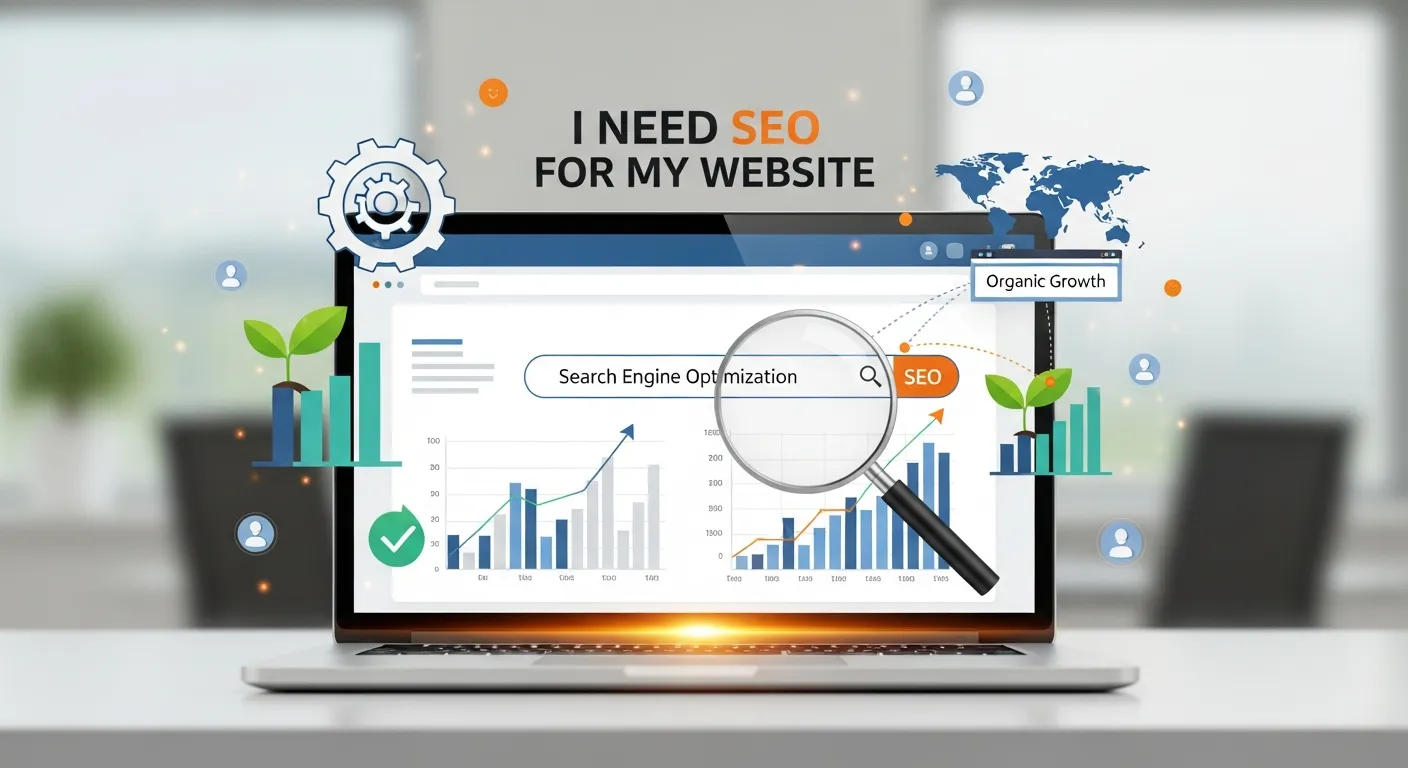
You just launched a brand new website. The design looks flawless, the copy reads sharply, and your products are ready for the market. A few weeks pass, and your analytics dashboard shows almost zero visitors. This frustrating scenario is exactly why business owners quickly find themselves asking one specific question: do I need seo for my website?
Search Engine Optimization (SEO) involves improving your website to increase its visibility on search engines like Google or Bing. When people search for products, services, or information related to your business, you want your website to appear at the top of those search results. Earning those top spots requires a deliberate, focused strategy. If nobody can find your pages, your beautiful design and perfect copy hold little value. Search engines act as the primary way people navigate the internet. This makes visibility a fundamental requirement for online success. Understanding how search optimization works and why it matters helps you answer the question, do I need seo for my website?
Why SEO is Crucial for Every Website

Relying entirely on paid advertising or social media algorithms proves to be a costly and unpredictable way to grow a business. Optimizing your site offers a more sustainable path by focusing on organic traffic. When you wonder, do I need seo for my website, consider the long-term value of organic growth.
Generating Consistent Organic Traffic
Organic traffic refers to visitors who land on your pages through unpaid search results. Unlike paid ads that stop generating traffic the moment your budget runs out, organic rankings provide a steady stream of visitors over months or even years. When your site ranks highly for relevant search terms, you attract users actively looking for exactly what you offer. This active intent makes organic traffic highly valuable. If you want sustainable growth without paying per click, do I need seo for my website becomes an easy question to answer.
- Cost-effective growth: Stop paying for every single visitor. Focusing on SEO for my website lets you attract more for less.
- High-intent users: Capture people ready to buy or learn. These visitors are more likely to convert.
- 24/7 visibility: Keep generating traffic even while you sleep. Your web presence never closes.
Did You Know? According to a recent study, over 60% of internet journeys begin on a search engine, making SEO for my website one of the most reliable traffic drivers available.
Organic vs. Paid Traffic

|
Traffic Source |
Cost per Click |
Sustainability |
User Intent |
Long-term Potential |
|---|---|---|---|---|
|
Organic (SEO) |
$0 |
Ongoing |
High |
Excellent |
|
Paid Ads |
$$$ |
Halts if the budget ends |
Varies (Often lower) |
Short-term |
As shown above, focusing on organic visitors is a strategic, long-term play—solidifying the ‘do I need seo for my website’ argument.
Building Trust, Authority, and Credibility
Search engines strive to provide the most relevant, high-quality answers to their users. Because of this, people naturally trust links that appear on the first page of Google. When you secure a top ranking for your website or business, it acts as an indirect recommendation. When evaluating, “do I need seo for my website,” remember:
- Users are 10x more likely to click top organic results than paid ads
- A high-ranking website quickly builds brand authority
- Trust equals higher conversion rates
A well-optimized site is viewed as trustworthy, helpful, and authoritative—qualities that not only win new customers, but also drive loyalty and repeat business.
Real-World Impact: Building Online Reputation
Suppose you Google services in your area and a business appears at the top with clean, informative content and reviews. You likely assume this business is credible. The same rule applies to your own site. The higher you rank, the stronger your reputation.
Compounding Long-Term Benefits
Creating a search strategy requires an initial investment of time and resources, but the long-term benefits are unmatched. A well-optimized piece of content can continue to attract thousands of visitors long after you publish it, unlike a social media post that quickly fades. As you build a library of SEO-optimized content and earn backlinks from reputable sites, your entire domain gains cumulative authority.
Key Points:
- SEO for my website reduces dependence on ongoing ad spending
- Compounding results: Each new piece of content strengthens your site
- Lower customer acquisition costs over time
- Passive lead generation
Do I need seo for my website? Yes, if you want your investment to produce consistent results years later.
Key SEO Elements You Need to Know
Search engine algorithms evaluate hundreds of different factors when deciding how to rank a site. These factors generally fall into three main categories. Many beginners ask, do I need seo for my website without knowing what it actually entails.
Comprehensive Overview of Optimization Elements
|
SEO Type |
Primary Focus |
Key Activities |
Importance Level |
|---|---|---|---|
|
On-Page |
Content and keywords on the site |
Keyword research, meta tags, content writing |
Critical for relevance |
|
Off-Page |
Authority outside the site |
Link building, social signals, digital PR |
Critical for authority |
|
Technical |
Backend performance |
Site speed, mobile optimization, crawlability |
Critical for indexing |
A successful approach requires a blend of each, optimized over time as your website matures.
On-Page Optimization in Detail
On-page optimization involves improving the content and structure of individual web pages. You must ensure your target keywords appear naturally in your titles, headings, and body paragraphs. Write helpful, high-quality content that directly answers the searcher’s intent.
Essential On-Page Elements:
- Title tags and meta descriptions, crafted for both users and search bots
- Headings (H1, H2, H3) structured to improve readability
- Alt text for all images so search engines can “see” your visuals
- Quality content with natural keyword integration (“do i need seo for my website” should appear thoughtfully in every key section)
- Internal linking to guide users to related topics
If you want to dive deeper into these foundational elements, you can review the Google SEO Starter Guide to understand better how search engines view your content.
Off-Page Strategy: Building Authority
Off-page elements refer to actions taken outside of your own domain that impact your rankings. The most prominent off-page factor is acquiring quality backlinks. Search engines interpret these as votes of confidence. But off-page SEO for my website is about more than just links:
- Participating in community forums
- Guest posting on relevant, reputable websites
- Earning social media mentions
- Gaining citations from news sources
With a healthy off-page profile, your site signals trust and relevance to search engines and potential site visitors.
Technical Foundation and Structure

Technical optimization lays the groundwork for your content to be found and indexed correctly. Without it, even the best content goes unseen.
Technical Must-Haves:
- Fast, responsive website (aim for <2 second load times)
- Secure site: SSL certificate is essential
- XML sitemap submitted to search engines
- Mobile-friendly, adaptive layout
- Clean, crawlable URLs
To get a broader understanding of how these technical pieces fit together, you can explore exactly what is SEO and how technical health dictates performance.
Technical SEO Checklist
|
Element |
Purpose |
How Often to Review |
|---|---|---|
|
Site Speed |
User experience, Google ranking |
Monthly |
|
Mobile Optimization |
Appealing to all users |
Quarterly |
|
Sitemap |
Ensuring all pages are found |
Anytime pages update |
|
SSL Certificate |
Security/trust |
Annually |
|
Clean URLs |
Simpler crawling & ranking |
At site refresh |
Applying SEO Strategy to Different Business Types
“Do I need seo for my website?” has a different answer depending on your goals and industry. Let’s look at common scenarios:
E-Commerce Stores
E-commerce SEO makes or breaks sales. With thousands of competitors, you must optimize:
- Product and category pages for targeted search terms
- Images with descriptive alt tags (product name, color, size)
- Reviews integrated for fresh, user-generated content
- Structured product data for richer search results
You’ll also want to focus on technical elements such as lightning-fast page speed and seamless checkout experiences. Even a one-second delay can cause customers to abandon their carts. Implementing SEO for my website in this way maximizes both reach and revenue.
E-Commerce SEO Table Example
|
Optimization Area |
Benefit |
Impact Level |
|---|---|---|
|
Unique Product Descriptions |
Stand out from copycats |
High |
|
Customer Reviews |
Increases trust & keyword use |
Medium |
|
Fast Mobile Checkout |
Prevents order drop-off |
Critical |
Local Businesses
If you rely on local customers—restaurants, clinics, plumbers—local SEO is vital.
- Claim your Google Business Profile and optimize it fully
- Match your name, address, and phone number (NAP) everywhere online
- Collect frequent reviews
- Use local keywords (e.g., “SEO for my website in Brooklyn”)
- Build location-specific landing pages
Example: If someone searches “best pizza near me” and you have implemented strong local SEO, your pizzeria will appear above competitors.
Content Publishers and Blogs
Monetizing through ads, affiliates, or memberships? SEO for my website means:
- Targeting informational and trending search queries
- Deeply exploring topics with long-form, authoritative content
- Updating evergreen articles
- Structuring categories for clear navigation
A focus on internal linking further boosts authority and helps readers stay longer on your site—signaling value to search engines.
Common Myths and Misconceptions
There is a lot of outdated advice circulating on the internet regarding search optimization. Falling for these myths can waste your time or actively harm your rankings.
“It is a one-time project”
Many people believe they can optimize their pages once during the launch phase and never touch them again. In reality, search visibility requires ongoing maintenance. Search engines update their algorithms constantly. Your competitors always publish new content, and consumer search habits change. Maintaining top rankings requires continuous monitoring and regular content updates. You must continually ask how to improve seo for my website—even after launch.
“Keyword stuffing improves rankings”
Years ago, webmasters could rank pages simply by repeating their target keyword dozens of times. Search engines are now incredibly sophisticated. Keyword stuffing will result in harsh penalties that tank your visibility. Write naturally for human readers. Use variations and synonyms of your main topic rather than awkwardly forcing the exact phrase into every sentence.
“More backlinks are always better”
Quality over quantity is the new reality. Do i need seo for my website that focuses on hundreds of spammy links? No. One link from a reputable source carries more weight than dozens from questionable sites. Aim for relevance and authority over sheer volume.
The Future of Online Visibility
Search technology evolves rapidly. Staying ahead of the curve ensures your brand remains visible as user behaviors shift. When asking do I need seo for my website going forward, you must consider these trends.
Artificial Intelligence
AI tools are changing the game by summarizing answers, organizing search results in new ways, and even crafting content outlines. Emphasize unique insights, original perspectives, and real-world experience—things AI can’t replicate with ease. Regularly refresh content to remain relevant in this evolving landscape.
Voice Search
Adapting your strategy for voice means thinking about conversational keywords and direct answers. People using voice assistants tend to ask broader, question-based queries. Including FAQ sections and natural language responses on your site gives you a better chance to be chosen as the answer for voice search.
User Experience (UX)
Google considers page experience signals such as Core Web Vitals—which track speed, visual stability, and responsiveness. Provide a seamless, enjoyable user experience across all devices to boost both SEO for my website and overall visitor satisfaction.
UX Factors That Influence SEO
|
User Experience Factor |
SEO Impact |
How to Optimize |
|---|---|---|
|
Loading Speed |
Improves rankings, lowers bounce |
Compress images, use fast hosting |
|
Mobile Friendliness |
Expands reach, higher mobile rank |
Responsive design, test on devices |
|
Easy Navigation |
Increases engagement, more pages read |
Simplify menus, use breadcrumbs |
|
Minimal Pop-Ups |
Reduces disruption, boosts time on site |
Limit pop-ups and intrusive ads |
Frequently Asked Questions
1. Do I need seo for my website if I already use social media?
Yes, social media provides short-term visibility, but search optimization offers long-term, sustainable traffic. Social media posts have a short lifespan, while well-optimized content can drive traffic for years. Utilizing the right strategies and best SEO tools ensures you capture users actively searching for your services, rather than just scrolling a feed.
2. How long does it take to see results from search optimization?
Optimization is a long-term strategy, and it typically takes three to six months to start seeing significant movement in your rankings. Search engines need time to crawl your site, assess your authority, and compare your content to competitors. Consistency in publishing and building technical health speeds up this timeline.
3. Do I need seo for my website if my business is strictly local?
Absolutely. Local search optimization ensures that people in your immediate area find your business when they search for relevant services. Setting up a Google Business Profile and using local keywords drives physical foot traffic directly to your door.
4. Can I handle my search optimization myself, or do I need an agency?
You can certainly learn the basics and handle on-page elements yourself, especially when you are just starting out. Many beginners handle keyword research and content creation independently. However, accessing the best SEO tools can greatly simplify your workflow and provide deeper insights as you scale.
5. What is the most important ranking factor?
There is no single “most important” factor, as search engines use hundreds of signals to evaluate pages. However, high-quality, relevant content that satisfies user intent combined with strong authoritative backlinks generally drives the best results. Technical health provides the necessary foundation for these elements to succeed.
6. Do I need seo for my website if I sell products on third-party platforms?
If you have your own standalone domain, you absolutely need to optimize it to drive direct sales. Relying solely on third-party platforms means you do not control your audience or your margins. Search optimization builds your independent brand authority.
7. How often should I update my old content?
You should review and update your top-performing pages at least once a year. Search engines favor fresh, accurate information. Updating statistics, adding new insights, and improving formatting can give older pages a significant ranking boost.
8. Is technical optimization really that important for a small blog?
Yes, technical health determines whether search engines can actually read your pages. If your site takes too long to load or fails on mobile devices, users will bounce, and search engines will demote your content. Keeping a clean, fast site is non-negotiable.
9. How do I track my search performance?
You can use free platforms like Google Analytics and Google Search Console to monitor your organic traffic and keyword rankings. As you grow, investing in premium tracking software helps you analyze competitors and find new opportunities. Leveraging the best SEO tools gives you a massive advantage in tracking specific metrics and backlink profiles.
10. Do I need seo for my website if I plan to buy ads anyway?
Yes, combining paid ads with organic optimization creates a dominant search presence. While ads get you immediate visibility, organic rankings build long-term trust and lower your overall customer acquisition cost. Optimizing your landing pages also improves your ad quality scores, saving you money on paid campaigns.
Final Thoughts
The question “do I need seo for my website” is more vital than ever in a digital landscape crowded with competition. Whether your goal is to boost sales, build authority, attract a local audience, or grow an international brand, SEO offers the most sustainable and cost-effective approach. As algorithms, trends, and tools change, your commitment to SEO for my website ensures you’ll stay visible, competitive, and trusted by your audience for years to come.
For those starting out or scaling up, don’t wait for your site to disappear among the noise. Invest in a proven strategy—invest in SEO for your website—and watch your digital presence grow exponentially.
