
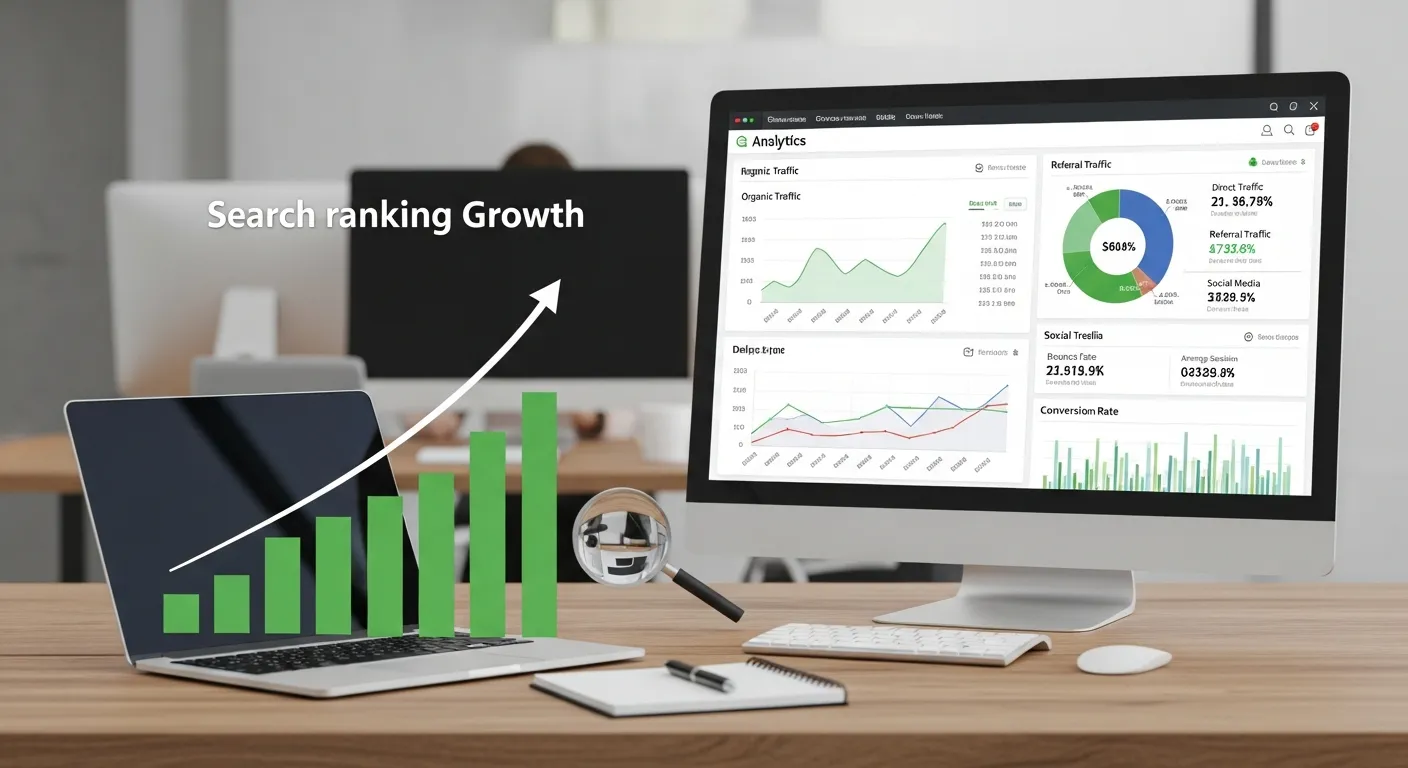
Search engine optimization helps websites increase visibility on Google by improving crawling, indexing, content, technical structure, and backlinks. This guide explains on-page, technical, off-page, and local SEO strategies to boost rankings and organic traffic sustainably.
Billions of searches happen on Google every single day. People are constantly looking for answers, products, services, and entertainment. If your website fails to appear on the first page of those search results, you are missing out on a massive amount of potential traffic. Visibility on search engines remains one of the most powerful drivers of business growth available today.
Search engine optimization is the direct process of improving your website to increase its visibility in search engines like Google or Bing. When you actively optimize your site, you drastically improve your chances of appearing at the top of search results when people look for terms closely related to your business.
Search engine optimization matters because organic search traffic is highly targeted. Users are actively looking for what you offer right at that moment. Unlike paid advertising, which immediately stops generating traffic the moment you stop paying your daily budget, a well-optimized website can attract targeted visitors for months or even years. This dynamic makes search engine optimization an incredibly cost-effective strategy for building brand awareness, capturing new leads, and driving sustainable revenue.
This comprehensive guide will walk you through the entire landscape of search engine optimization. You will learn exactly how search engines actually work, how to execute flawless on-page SEO, the technical requirements for a perfectly healthy site, and how to build authority across the web. We will also deeply cover local SEO strategies, analytics, and the most common mistakes beginners make. In addition, this updated edition includes advanced tips, a comparison of key SEO tools, and actionable steps to upgrade your strategy even further.
The Fundamentals of Search Engine Optimization
To properly execute search engine optimization, you first need to understand exactly how search engines operate. Search engines essentially have three primary functions: discovering content, storing it, and displaying it to users based on relevance and quality.
Crawling: Discovering Content

Search engines use automated bots, often called crawlers or spiders, to scour the vast internet. These bots constantly follow links from one web page to another, discovering brand new content along the way. If your website has absolutely no links pointing to it, or if your internal site structure blocks these bots, search engines will not know your content exists. Effective SEO strategies ensure that crawlers can easily navigate your entire website structure.
A useful tip to boost crawling: add clear navigation menus and an HTML sitemap, so bots (and users) can access important pages even if they’re buried deep in your site.
Indexing: Organizing and Storing Content
Once a crawler discovers a page, the search engine tries to understand what the page is actually about. This specific process is called indexing. The search engine deeply analyzes the text, images, and video files on the page and stores this crucial information in a massive database called the index. When a user performs a search, the search engine rapidly pulls the most relevant results directly from this index.
When your site structure is logical and you use headers correctly, your indexed pages will be easier to match to user searches. Make sure all important resources (PDFs, videos, images) have descriptive metadata, as this helps the search engine understand how to properly categorize each part of your content.
Ranking: Displaying Relevant Content to Users
When someone types a query into a search box, the search engine scours its index for highly relevant content. It then uniquely orders that content to perfectly solve the searcher’s problem. This ordering of search results by relevance is known as your search engine ranking. The higher a page ranks, the more relevant the search engine believes that page is to the specific query. Improving your search engine ranking is the ultimate goal of search engine optimization.
Ranking is based on dozens—sometimes hundreds—of factors ranging from keyword optimization to user experience metrics like bounce rate and dwell time. Search engines are increasingly using artificial intelligence to understand content relevance and user intent, so outdated tricks (like keyword stuffing or link farming) are now more likely to harm than help.
Key Elements That Influence Search Engine Ranking
- Quality of content: Up-to-date, accurate, and comprehensive pages rank higher.
- User experience (UX): Is your site easy to read, fast, and mobile-friendly?
- Backlink profile: Are other high-quality sites linking to you?
- On-page SEO: Are you using target keywords naturally, optimizing headers, and providing rich value?
|
Search Engine Function |
Definition |
Impact on Search Engine Optimization |
|---|---|---|
|
Crawling |
Bots discovering your web pages through links. |
Poor crawling means your site remains invisible. |
|
Indexing |
Storing your page information in a database. |
Unindexed pages cannot achieve a search engine ranking. |
|
Ranking |
Ordering results based on relevance and authority. |
Higher ranking directly drives more organic traffic. |
Mastering On-Page SEO for Better Visibility

On-page SEO refers to absolutely everything you can control directly on your own website. This broad category includes the actual content you publish, the HTML source code of your pages, and the overall user experience.
The Power of Keyword Optimization
Keyword research forms the absolute foundation of any successful search engine optimization campaign. You need to know exactly what words and phrases your target audience actually uses when searching for your products or services online.
You must focus on a healthy mix of short-tail keywords (broad terms like “shoes”) and long-tail keywords (highly specific phrases like “comfortable running shoes for flat feet”). Long-tail keywords often have significantly less competition and much higher conversion rates. To master this area, you should explore a comprehensive keyword optimization guide to understand exactly how to map user intent to your web pages.
Proper keyword optimization requires using tools like Google Keyword Planner to find keywords with solid search volume and highly manageable competition. But keyword research isn’t just about picking popular terms. Consider user intent: Is the person searching for information, a product, a service, or a solution to a specific problem? Choose keywords that match what your ideal visitor actually wants to find.
Effective Keyword Planning
|
Keyword Type |
Example Phrase |
Competition |
Conversion Rate |
|---|---|---|---|
|
Short-tail Keyword |
“SEO” |
High |
Low |
|
Long-tail Keyword |
“best SEO strategies for e-commerce” |
Low |
High |
|
Branded Keyword |
“Acme SEO Tools” |
Medium |
Medium |
|
Location-specific Keyword |
“on-page SEO expert in Dallas” |
Low |
High |
Tips for Smart Keyword Placement:
- Place your primary keyword in the page title, first paragraph, one header, and meta description.
- Sprinkle secondary (related) keywords throughout the text naturally.
- Use keyword-rich file names for images.
- Create FAQ sections targeting common long-tail search phrases.
Content Optimization Strategies
Content remains the most critical element of on-page SEO. Search engines actively want to rank pages that provide the absolute best possible answers to users’ pressing questions.
- Create High-Quality Content: Write content that genuinely helps your readers solve a problem. It should be accurate, comprehensively detailed, and highly engaging.
- Natural Keyword Integration: Use your target keywords naturally throughout the text. Avoid “keyword stuffing,” which is the dangerous practice of jamming keywords into your content unnaturally.
- Maintain Content Freshness: Keep your content up to date. Outdated information provides a remarkably poor user experience and can severely harm your search engine ranking over time.
Pro-Level On-Page SEO Content Checklist
- Compelling headlines (use H1 for main heading, H2/H3 for sub-sections)
- At least 1000 words per main blog post
- Original graphics or images with descriptive alt text
- Embedded video when possible to improve engagement
- FAQs to address long-tail keyword variations
- Internal and external links to related resources
Title Tags and Meta Descriptions
These crucial elements appear directly in the search engine results pages (SERPs) and heavily influence whether a user actually clicks on your link. A compelling title and description can easily convince a user to choose your site over a direct competitor. Keep title tags under 60 characters and meta descriptions under 155 characters. Always include your primary keyword in both for strong keyword optimization.
Your meta description should not just summarize the content, but give a reason to click—like “Discover proven strategies to maximize your search engine optimization and outrank competitors.”
Examples:
- Good Title Tag: Master On-Page SEO: 10 Proven Strategies to Improve Your Search Engine Ranking
- Good Meta Description: Unlock SEO strategies to boost your search engine ranking. Learn keyword optimization, content tips, and easy updates for fast results.
Technical SEO: The Backbone of Search Engine Optimization

Technical SEO involves optimizing your website’s hidden infrastructure so search engines can easily crawl and index your site. Without strong technical foundations, even the best on-page SEO will completely fail.
XML Sitemaps and Robots.txt
An XML sitemap is a highly specific file that lists all the important pages on your website. Submitting a comprehensive sitemap to Google Search Console ensures that search engines can easily find and crawl all your essential pages. Meanwhile, the robots.txt file guides crawlers, telling search engine bots exactly which pages they are allowed to crawl and which ones they should completely ignore.
Essential Technical SEO Elements
|
Element |
Function |
Best Practice |
|---|---|---|
|
XML Sitemap |
Guide search engines to key pages |
Submit to Google/Bing consoles |
|
Robots.txt |
Restrict or allow crawler access |
Block duplicate/irrelevant pages |
|
Canonical Tags |
Declare preferred page version |
Prevent duplicate content issues |
|
HTTPS |
Secure content and user data |
Mandatory for SEO ranking |
|
Structured Data |
Help search engines “read” content |
Add schema markup for rich results |
Site Speed and Core Web Vitals
Google actively monitors how users interact with your site. Your website must load incredibly quickly and look absolutely great on mobile devices. Core Web Vitals are highly specific metrics Google uses to measure user experience, focusing heavily on loading performance, interactivity, and visual stability. Fast sites earn a much better search engine ranking.
Key Core Web Vitals:
- LCP (Largest Contentful Paint): Measures loading performance. Ideal: 2.5s or less.
- FID (First Input Delay): Measures interactivity. Ideal: 100ms or less.
- CLS (Cumulative Layout Shift): Measures visual stability. Ideal: 0.1 or less.
Ways to Improve Site Speed
- Use image compression and next-gen formats (WebP, AVIF)
- Leverage browser caching and server-side compression
- Remove unnecessary plugins and scripts
- Use content delivery networks (CDNs)
Advanced Technical SEO Considerations
Delving deeper into technical SEO, it’s vital to consider advanced topics as your site grows:
Mobile-First Indexing
Google primarily uses the mobile version of your website for indexing and ranking. If your site isn’t mobile-friendly, your rankings will suffer—regardless of how well you optimize for desktop. Prioritize responsive design, legible fonts, quick-loading images, and accessible navigation for mobile users.
Structured Data and Schema Markup
Schema markup is a type of code you add to your site to help search engines better understand your content. With structured data, you can unlock enhanced search results—like star ratings, recipe cook times, or event listings—that make your page stand out and increase click-through rates.
Popular Schema Types
|
Schema Type |
Example Use |
SEO Benefit |
|---|---|---|
|
Article |
Blog/news pages |
Rich results in SERPs |
|
Product |
E-commerce listings |
Price/availability in search |
|
Local Business |
Small/local services |
Enhanced map and contact info |
|
FAQ |
Question-answer pages |
Collapsible rich snippet in SERPs |
Off-Page SEO Strategies for Building Authority
Off-page SEO involves deliberate actions taken outside of your own website to positively impact your search engine ranking. This primarily revolves around building high-quality backlinks and establishing your brand’s overall authority in your industry.
Backlinks and Link Building
Backlinks are simply links from other websites pointing directly to your website. Think of them as digital votes of confidence. When a highly reputable site links to yours, it passes along “link juice,” massively boosting your site’s authority.
Effective SEO strategies focus on earning high-quality backlinks through active outreach. You can utilize guest posting, broken link building, and the skyscraper technique to earn mentions from authoritative websites. Remember, a single backlink from a highly trusted site is worth far more than dozens of links from low-quality, spammy web directories.
Easy Backlink Building Methods
- Find broken links on top sites in your niche and offer your own content as a replacement
- Publish original research or unique data and share it with industry blogs or news outlets
- Guest post on leading blogs and include contextual links to your site
- Create link-worthy resources (tools, calculators, comprehensive guides)
Local SEO Strategies to Dominate Geographic Searches
If you run a local business with a physical location or serve a highly specific geographic area, executing local SEO strategies is absolutely crucial for your success.
Google Business Profile Optimization
Your Google Business Profile serves as the most important element of local search engine optimization. You must claim your profile, ensure your business name, address, and phone number are perfectly accurate, and upload high-quality photos. Furthermore, you need to actively encourage satisfied customers to leave positive reviews, as local reviews strongly influence your local search engine ranking.
Local Citations and Directories
A citation is any mention of your business info on an external website—especially in business directories. Consistency across these listings is essential. Inaccurate info can lower your search engine ranking, so keep your NAP (Name, Address, Phone) up to date everywhere.
Key Local Directories to List Your Business
- Google Business Profile
- Yelp
- Bing Places for Business
- TripAdvisor (relevant for hospitality and service businesses)
- Industry-specific directories
Measuring Search Engine Optimization Success
You cannot improve what you do not measure. Actively tracking your SEO strategies is vital to understand exactly what is working and what urgently needs adjustment.
Setting and Tracking SEO KPIs
Define clear key performance indicators (KPIs) tied to your overall business goals:
- Organic traffic from search engines
- Keyword rankings for priority terms
- Click-through rates (CTR) from search results
- Bounce rate and dwell time on key pages
- Conversion rates (leads, sales, signups)
Sample SEO Metrics and Tools
|
Metric |
Tool |
SEO Value |
|---|---|---|
|
Organic Traffic |
Google Analytics |
Measures non-paid audience size |
|
Keyword Ranking |
SEMrush, Ahrefs, Moz |
Tracks progress for top terms |
|
Backlinks |
Ahrefs, Moz |
Monitors off-page authority |
|
Core Web Vitals |
Google PageSpeed Insights |
Optimizes site performance |
|
Local Listings |
BrightLocal, Moz Local |
Ensures consistency |
Advanced SEO Analytics
- Use heatmaps (Hotjar, Crazy Egg) to see how users interact with your content
- Set up conversion tracking for forms, sales, or calls
- Create dashboards to monitor performance over time
Common Search Engine Optimization Mistakes to Avoid
Many website owners unknowingly harm their search visibility by making highly preventable errors. Avoid stuffing keywords into your text, as this makes the content unreadable and immediately triggers search engine penalties. Do not ignore mobile optimization; a site that is difficult to use on a smartphone will be pushed aggressively down in the rankings. Finally, avoid buying backlinks at all costs. Search engines are incredibly adept at identifying artificial link schemes, and participating in them can get your site completely removed from the index.
Top Mistakes and How to Fix Them
- Ignoring mobile users: Always preview your site on multiple devices.
- Over-optimizing with keywords: Write for people first—then adjust for search engines.
- Slow load times: Audit images, scripts, and use speed optimization tools regularly.
- Neglecting analytics: Review data monthly to spot trends, wins, or technical issues.
- Not updating content: Refresh existing posts regularly to maintain search engine ranking.
Conclusion: Start Your Search Engine Optimization Journey
Search engine optimization is a highly rewarding, long-term strategy that requires patience, consistency, and a relentless focus on providing real value to your users. By understanding exactly how search engines work and applying the on-page SEO, technical SEO, and off-page SEO strategies outlined in this extensive guide, you can build a highly strong foundation for exponential organic growth.
Begin by fully auditing your current website today. Identify your target keywords, fix any lingering technical errors, and start creating high-quality content that perfectly answers your audience’s questions. The earlier you start optimizing your web properties, the sooner you will see the massive, compounding benefits of a top search engine ranking. Remember to continuously test, iterate, and stay informed about new SEO trends to keep your advantage in a constantly changing digital landscape.
Frequently Asked Questions
What exactly is search engine optimization?
Search engine optimization is the continuous process of improving your website to increase its organic visibility on search engines like Google. By applying various SEO strategies, you make your site more appealing to search algorithms. This helps you capture highly targeted traffic without paying for ads.
How long does it take to see search engine optimization results?
Search engine optimization is a long-term strategy, and it typically takes three to six months to see significant results. Search engines need time to crawl, index, and evaluate your newly implemented on-page SEO changes. Consistency and patience are absolutely required for sustained success.
What is the main difference between on-page SEO and off-page SEO?
On-page SEO involves optimizing elements directly on your website, such as content, meta tags, and keyword optimization. Off-page SEO refers to actions taken outside your website, like earning backlinks and building brand authority. Both are essential for a high search engine ranking.
Why is keyword optimization so important?
Keyword optimization helps search engines understand the specific topic and intent of your web pages. By placing the right terms naturally in your text, you match what users are actually searching for. This directly improves your search engine ranking for those specific queries.
What are the best free tools for search engine optimization?
There are many excellent free tools available to help you audit your site, research keywords, and track performance. You can read about the top 12 free SEO tools and tips to get started without spending any money. Google Search Console and Google Analytics are also essential free platforms.
Does website speed affect my search engine ranking?
Yes, website speed is a confirmed and highly critical ranking factor for Google and other search engines. Slow websites provide a very poor user experience, leading to high bounce rates. Improving your loading times is a fundamental part of technical search engine optimization.
How do backlinks improve my SEO strategies?
Backlinks act as digital votes of confidence from other websites, signaling to search engines that your content is valuable and trustworthy. The more high-quality backlinks you earn, the higher your domain authority becomes. This makes it significantly easier to achieve a top search engine ranking.
Can small businesses succeed with search engine optimization?
Absolutely, small businesses can achieve massive success by focusing heavily on local SEO and highly specific long-tail keywords. To stretch your budget further, you should utilize designed specifically for smaller operations. Competing locally is highly achievable with the right approach.
What is keyword stuffing and why should I avoid it?
Keyword stuffing is the outdated practice of unnaturally forcing a target keyword into your content as many times as possible. Search engines view this as spam, and it severely damages the readability of your text. Proper keyword optimization should always read naturally to human visitors.
Where can I learn more about applying SEO strategies on a budget?
You do not need an enormous marketing budget to begin implementing highly effective search engine optimization techniques. By leveraging the you can audit your site and conduct keyword research completely for free. Focus on creating great content and the rankings will follow.
